Durham County terrain features heavy clay soil and high summer humidity that combine to create persistent insect breeding reservoirs. In established neighborhoods such as Forest Hills, Trinity Park, and…
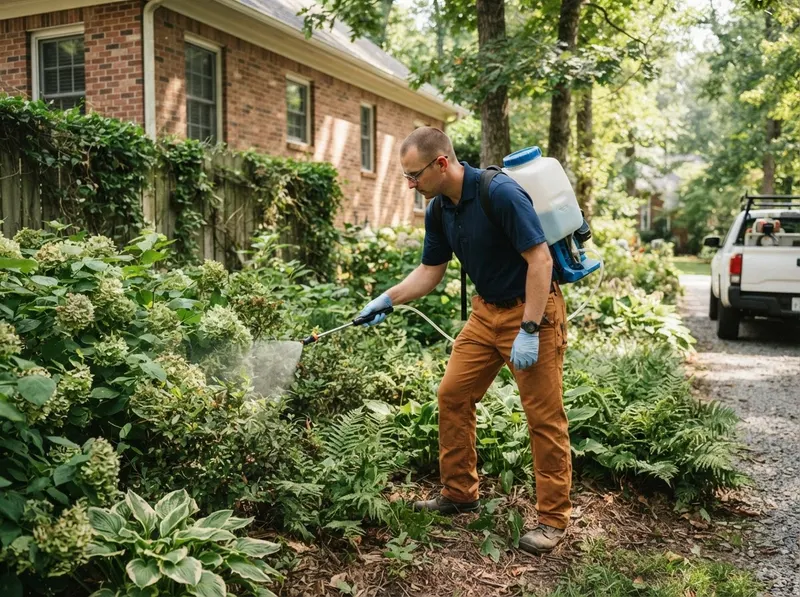
Durham County terrain features heavy clay soil and high summer humidity that combine to create persistent insect breeding reservoirs. In established neighborhoods such as Forest Hills, Trinity Park, and Watts-Hillandale, mature hardwoods like post oaks and sweetgums provide continuous shaded canopies where adult Aedes albopictus mosquitoes rest during daylight hours. Outdoor suppression operates by applying micro-encapsulated formulations directly to the undersides of broadleaf foliage, ornamental shrubs, and shaded fence lines up to a height of 10 feet. When adult insects land on treated leaf surfaces, the residue disrupts their nervous system, driving an immediate structural perimeter around residential living spaces.
Property topographies across Southpoint and Brightleaf at the Park frequently incorporate municipal drainage ditches, low-lying swales, and retention ponds that hold stagnant rainfall. Suppressing biting populations requires treating these active water reservoirs with biological larvicides containing Bacillus thuringiensis israelensis (BTI). This bacterium releases crystal proteins that kill mosquito larvae within 24 hours while remaining non-toxic to amphibians, reptiles, and household pets. Retail foggers and store-bought pyrethrin aerosol cans break down under direct ultraviolet sunlight within 48 to 72 hours, leaving eggs to hatch uninterrupted. Professional outdoor suppression bonds to plant cuticle waxes, maintaining residual protection through rain events for 21 to 30 days.
Outdoor pest suppression extends beyond mosquitoes to eliminate deer ticks and cat fleas migrating from wooded corridors near the Eno River State Park basin and Duke University West Campus. Properties in Old North Durham and Northgate Park with unmanicured perimeter leaf litter or pine straw borders require a ground-level broadcast application up to 15 feet out from foundation walls. If a property features a dense woodland edge, technicians apply a granular barrier along the perimeter line; if the boundary is open lawn, a liquid barrier treatment delivers optimal coverage. The practical trade-off centers on vegetation density: properties with thick shrubbery require larger liquid reservoir volumes to achieve complete foliar saturation, whereas cleared turf environments require less chemical volume but benefit more from granular perimeter bands.
1. Technicians survey property drainage swales, gutters, and downspout catch basins for stagnant water accumulation. 2. Granular or briquette larvicides are placed directly into standing retention areas to neutralize aquatic larvae. 3. Low-volume air-assisted backpack misters coat the undersides of perimeter trees, perimeter shrubs, and foundational masonry up to a vertical height of 10 feet. 4. Treated areas are left undisturbed for 45 minutes until spray residues completely dry onto surfaces.
Every job gets a firm, written price after a free on-site visit.
Tell us about your mosquito and outdoor pest suppression job in Durham and we'll send a clear, written quote, usually the same day.
 HomeFort Pest Control